Ohne Kommentare
Sin comentarios
No comments
Ohne Kommentare
Sin comentarios
No comments
Wer in Europa lebt, sagt gerne mal hoch-alpin und meint damit die vegetationsfreien Höhen ab ca. 2500 m. Hierzulande sind das gemäßigte Höhen mit „Sommerfrischen“ und „Badeplätzen“ zur Erholung der Großstädter. Hoch-andin sind die Straßen und Städte hier ab ca. 4000 m. Allerdings gebraucht hier niemand diese Bezeichnung, denn die Höhen sind alltäglich. Zwischen Lima (Meereshöhe) und Huancayo (3400 m) über den Ticlio-Pass (4818 m) verkehren täglich Dutzende von Bussen und – vermutlich – einige tausend PKW. In den Zeiten, in denen Clemen in ihrem VW-Käfer in dieser Gegend unterwegs war, war ihr Auto ein einsamer roter Punkt, der sich langsam über die weitgehend ungeteerte Gebirgsstraße in die Höhe quälte. Heute hat sich der Anblick geändert … hoffen wir, dass die vielen bunten Punkte, die in unendlicher Folge und mit hohem Tempo heute über den geteerten Ticlio-Pass brausen, einen echten wirtschaftlichen und politischen Fortschritt des Landes widerspiegeln und nicht nur den Ansprüchen eines gesteigerten Konsumverhaltens entsprechen.
Ich, Jürgen, hatte vor diesen Höhen ein bisschen Angst, weil ich nicht wusste, wie unser Auto sich verhält und wie wir selbst mit diesen Höhen zurechtkommen würden.
Nach fünf Andenüberquerungen (von West nach Ost und umgekehrt) können wir nur sagen: halb so schlimm, wenn man ein paar Dinge berücksichtigt:
Wenn man das alles beherzigt, kann eigentlich nichts schiefgehen. Wir haben diese Regeln trotzdem hier zusammengefasst, weil viele Autowracks am Straßenrand und in manchen Andentälern davon zeugen, dass nicht selbstverständlich ist, was eigentlich jedem einleuchten müsste.
Noch im vergangenen Jahr ging es bei uns von San Pedro de Atacama in Chile Richtung Salta in Argentinien. Das war zwar der bisher höchste Pass mit 4900 m, aber die Straße ist auf beiden Seiten sehr gut ausgebaut und wir konnten die wunderbare Landschaft beim Fahren genießen:
Eigentlich wollten wir dort oben sogar übernachten; genau genommen am Rande des Salar de Aguas Calientes, wo wir einen Stellplatz mit herrlichem Blick über den Salzsee gefunden hatten. Aber nachdem wir schon alles für die Übernachtung in 4600 m Höhe vorbereitet hatten, kam Clemen die gute Idee, doch einmal das Auto zu starten, um zu sehen, ob das überhaupt funktioniert. – Zum Glück hat es funktioniert, aber nur mit äußerster Mühe und nach einigem „Orgeln“. Mein Fehler: Ich hatte den Motor sofort nach dem Anhalten gewohnheitsgemäß ausgeschaltet (s.o.).
Da wir kein Risiko eingehen wollten (schließlich erwarteten wir zusätzlich zur Höhe auch eine ziemlich kalte Nacht), entschieden wir uns, doch noch weiterzufahren. Kurz hinter der Grenze nach Argentinien blieben wir dann in Súsques (3600m), einem kleinen Andendorf, vor einem „Motel“ stehen, der einzigen Unterkunft, die geöffnet war, und übernachteten dort:
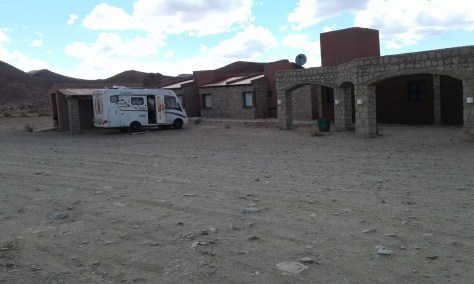
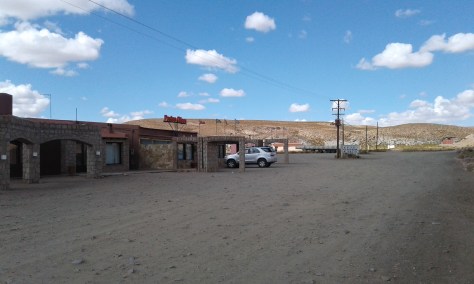
 Am nächsten Morgen machten wir einen Spaziergang durch den ziemlich abgelegenen Ort, in dem es auch eine sehenswerte Kirche gibt, die aus Lehm gebaut wurde. Leider war sie geschlossen:
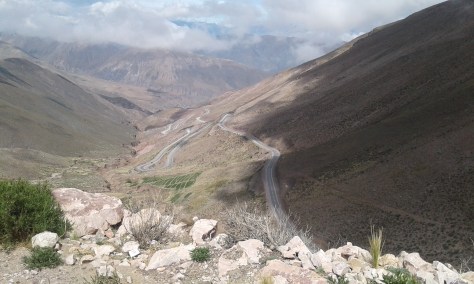
Dann ging es weiter hinab Richtung Jujuy, dem nächsten größeren Ort in Argentinien. Die Fahrt durch ein tief eingeschnittenes Andental war atemberaubend schön, mit einer wahrlich hoch-andinen, aber sehr gut ausgebauten Straße:

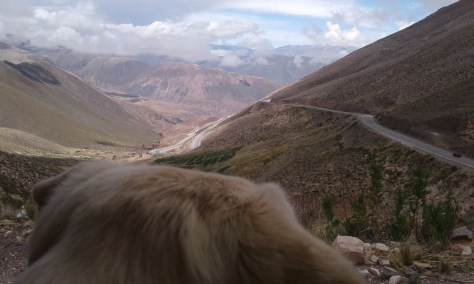
Heute, am 2. Januar 2017 (ein glückliches neues Jahr 2017 (link einbauen) an alle unsere „follower“), wollen wir zurück nach Chile und müssen wieder über die Anden. Wir wissen, dass der größte Teil des Passes nicht geteert ist und dass es vor allem auf der chilenischen Seite einige extrem steile Passagen gibt. Wir wollen es trotzdem wagen und machen uns schon um 7 Uhr früh auf die 270 km lange Strecke.

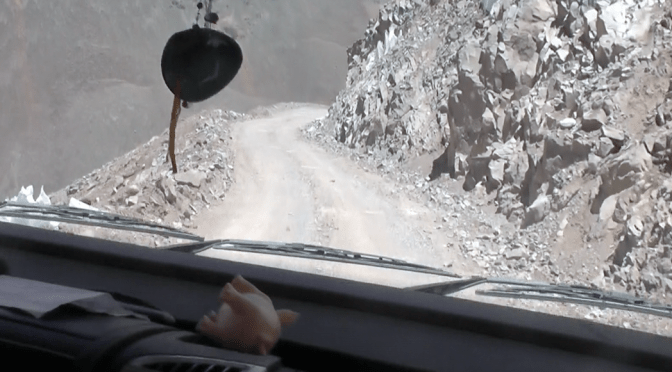
Bergauf sitzt Clemen am Steuer. Und je höher wir kommen, desto enger wird die Straße. Leitplanken gibt es dort oben natürlich auch nicht und die Abgründe sind ziemlich steil und tief. Clemen fährt zügig und sicher, wie mir scheint. Für meinen Geschmack manchmal ein bisschen zu zügig und selbstsicher, – daher mein gelegentliches Stöhnen im Video.
Aber sie schafft es ohne Probleme und unsere Esperanza muss nicht einmal schnaufen. Oben angekommen machen wir eine Essenspause, bewundern die grandiose Landschaft mit Gipfeln bis zu 6000 m Höhe, führen Shanti etwas spazieren und machen uns dann auf die Fahrt nach unten; diesmal sitze ich am Steuer.
Wir sind heilfroh, als wir um 11 Uhr in der Nacht in Vicuña in Chile ankommen, der Stadt, in der Gabriela Mistral, die erste weibliche Nobelpreisträgerin für Literatur, geboren wurde. Unter ihren Reimen schlafen wir tief und fest in dieser ersten Nacht in Vicuña.
Dass die Fahrt so lange dauerte, hatte aber nicht nur mit dem Straßenzustand zu tun, sondern vor allem auch mit den Grenzkontrollen und den damit verbundenen Wartezeiten:
Auf der argentinischen Seite brauchten wir 2 ½ Stunden, bis wir ausreisen durften. Während wir warteten, formulierte ein anderer Reisender, der sich – wie viele andere, die unserem Hund begegnen und sich in Shanti „verlieben“ – diesen Satz: “Liebe Frau, möge das Leben Sie weiterhin überraschen!“. Diesen Satz wollen wir mit unseren “followern” im Jahre 2017 teilen.
Auf der chilenischen Seite mussten wir geschlagene 5 Stunden warten, bis wir an der Reihe waren und schließlich alle Papiere kontrolliert und der Wohnwagen minutiös bis in den letzten Winkel kontrolliert worden war. Das hatte auch damit zu tun, dass viele Argentinier nach Chile reisen, um dort Ferien zu machen und einzukaufen. Nach der Regierung unter Cristina Kirschner sind die Preise in Argentinien unter der neuen Regierung sprunghaft in die Höhe geschossen und Chile ist für viel Argentinier zu einem Einkaufsparadies geworden.
Das war der bisher längste und anstrengendste Grenzübertritt auf unserer gesamten Reise mit knapp 40.000 km und mehr 13 Ländern.
Demnächst wird unsere Panamericanafahrt anderthalb Jahre alt … Wie die Zeit vergeht.
JW/Clea
Superandino
Quien vive en Europa dice con gusto a veces hoch-alpin y con esto las alturas libres de vegetación aprox. A 2500 m.s.n.m. Por estos lares son alturas mesuradas con ¨Sommerfrischen¨ y ¨lugares de baño¨ para recuperarse de las ciudades.
Hoch-andin o super-andino sería acá apartir de los 4000 m.s.n.m. Nadie usa ese término inventado por nosotros, porque aquí alturas de 4000 m.s.n.m es cotidianidad. Entre Lima (a nivel del mar) y Huancayo (3400 m.s.n.m.,.) transitan – pasando por Ticlio con 4 818 m.s.m. m – diariamente algunas docenas de buses e – imaginamos algunos miles de autos. En la época en que Clemen andaba por esos sitios en su escarabajo rojo, era su autito un punto rojo solitario que se esforzaba para alcanzar las alturas. Hoy el panorama hacambiado … esperemos, que los muchos puntos de colores que en línea interminable a velocidad apuran sobre el Ticlio asfaltado, sean una expresión de progreso económico y político del país y no solamente estén al servicio de las exigencias de un comportamiento consumista exacerbado.
Yo Juergen, tenía algo de temor a la altura, sobre todo no sabía cómo iba a portarse nuestro auto.
Hoy después de 5 cruzadas de los Andes de Oeste a Este y al revés), no es tan dramático si consideramos algunos detalles:
El año pasado pasamos de San Pedro de Atacama en Chile hacia Salta en Argentina. Fue el paso más alto que hemos tenido con 4900 m.s.n.m., el paso de Jama. El Paso de Jama está muy bien señalizado y muy bien construida la carretera lo que nos facilitó disfrutar mucho de ese lugar tan bello y conmovedor.
Queríamos pasar la noche al borde del Salar de Aguas Calientes, donde encontramos un lugar hermoso con vista al lago de sal. Cuando tuvimos todo listo para la noche a 4,600 m.s.n.m. Clemen sugirió encender el motor una vez más. El auto encendió pero con mucha dificultad. Mi error: apagué el motor inmediatamente después de llegar.
No quisimos finalmente asumir ese riesgo. Los vientos además adelantaban una noche muy muy fría … continuamos el camino. Poco después de la frontera encontramos un lugar en Susques a 3 600 m.s.n.m., un pueblito argentino con un único hotel funcionando.
Al día siguiente caminamos un poco por el pueblo donde había una capilla de adobe muy hermosa por fuera. Lamentablemente no pudimos entrar.
Luego continuamos en dirección Jujuy, el siguiente lugar más grande en Argentina. El trecho a través de un valle andino fue impresionante que nos dejaba a veces sin aliento de hermoso en una carretera super andina, además muy bien construida.
Hoy, 2 de Enero del 2017 (feliz año a todos nuestros seguidores!!!!!) volvemos a Chile a través de los Andes por el paso de Agua Negra. Sabemos que la mayor parte del camino es ripio y que hay pasajes muy empinados y peligrosos. Como estuvimos informados de lo especial del camino salimos tempranos a las 7 de la mañana para hacer los 270 km que nos esperaban.
Cuesta arriba está Clemen al volante. Mientras más arriba vamos, más angosta se pone la carretera. Barras auxiliares de contención brillan por su ausencia de tal manera que se pueden ver muy bien los precipicios más abajo. Clemen maneja rápido y segura, como me parece. Para mi gusto un poco demasiado rápido… por eso mis lamentos a veces en el vídeo.
Pero lo logra sin problemas y nuestra Esperanza lo logra sin mayor esfuerzo. Arriba en la cuesta a casi 6000 m.s.n.m. hacemos una pausa para comer algo. Shanti sale a caminar y a inspeccionar el área… luego nos vamos cuesta abajo, esta vez yo al volante.
Estamos dichosos de llegar a las 11 de la noche en Vicuña en Chlie, la tierra de la poetisa y primera mujer que recibió un premio Nóbel: Gabriela Mistral. Bajos sus rimas dormimos largo y tendido esa primera noche en Vicuña.
El hecho que el camino fuera tan largo no tiene que ver con la distancia misma del trecho, sino con los controles fronterizos. En la parte argentina estuvimos esperando 2 horas y media. En medio de la espera un señor que se encariñó con Shanti – donde va, lo aman – me dijo esta frase que se la paso a nuestros lectores: `señora que la Vida la sigua sorprendiendo! frase que pasamos con gusto a nuestros seguidores para el 2017.
En la parte chilena significó 5 horas de espera hasta que controlaron todos los papeles y el auto fue exhaustivamente controlado. Sucede también que muchos argentinos pasan para Chile a vacacionar, porque hoy, luego del gobierno de Cristina todo está por las nubes en Argentina y para los últimos Chile es un país de ocasión en estos momentos.
Este ha sido el control fronterizo más exigente en nuestro viaje… casi 40 000 Km y más de 13 países. Y el Panamericanafahrt va para cumplir el año y medio … cómo pasa el tiempo!
JW/Clea
High-andean
Those who live in Europe like to use the expression „high-alpine“ when referring to heights above 8000 feet, without much vegetation. In this area here such heights are places, where you find nice … and …., where people from the big cities go to relax during the weekend. High-andine are the roads and cities over 13,000 feet. But nobody uses this expression, because these heights are normal. There are dozens of coaches and – probably – thousands of passenger cars, which travel between Lima (on sea-level) and Huancayo (11,000 feet high) over the Ticlio pass with almost 16,000 feet every day. During the times, when Clemen was on the road in her red VW-beetle, it was a lone red star, which slowly crept up over the mostly untarred road. Today the view has changed remarkably … let’s hope that the countless colored dots, which quickly cross the mountain road today are a sign of real economic and political growth and not only a symbol of an growing consumerism.
I, Jürgen, was a little afraid of these heights myself, because I did not know, how our car would behave in these heights and how we would deal with the heights ourselves.
After five crossings over the Andes (from West to East and the other way round) we can only say: it is not as bad as we expected, provided you observe some basic rules:
If you take all these things to heart, you should be fine. Still we have put together these rules here, because lots of wrecks along the roads and in some valleys in the Andes prove, that nothing is granted for sure, even it is easy to understand.
Shortly before the end of last year we drove from San Pedro de Atacama to Salta in Argentina. The pass, which we had to cross on the way, was the highest so far with 16,000 feet, but the road is excellent in Chile and in Argentina and we had time to enjoy the impressive landscape.
Originally we wanted to spend the night near the height of the pass on the benches of the Salar de Aguas Calientes, with a beautiful view across the salt-lake pan. After we had already prepared everything for the overnight stay about 15,000 feet above sea-level, Clemen suggested to start the engine of Esperanza just for a try and find out, whether it would still start running. – Fortunately it finally worked, but only after a long and agonizing slow grudging of the engine. My fault: Like usual I had switched off the engine immediately after arriving instead of letting it idle for some time in the height and allowing the electronics to adapt to the new parameters.
Since we did not want to take any risk (especially because we were also expecting a cold night), we decided to go on. Shortly after the border to Argentine we stayed overnight in Súsques, a small Andean town (almost 12,000 feet high) in front of a modest motel, the only place to stay, which was open.
The next morning we took a short walk through the rather remote place, in which there is an old church made of clay and worth a visit. Unfortunately it was closed.
After that we continued our trip across the Andes with Jujuy being our next destination. The drive through a deep valley cut into the Andes was breathtaking with a really high-andean but very good road.
Today we want to go back to Chile and have to cross the Andes again. This time from East to West. We know, that the biggest part of the pass will not be tarred and we also know that there will be some extremely steep passages on the Chilean side. We still want to take the risk and start the 170 mile trip at 7 0’clock in the morning.
Uphill Clemen is driving. And the higher we get the narrower the road becomes. There are no guard railings along the road up here and the abysses are very, very deep. Clemen is driving and she drives speedily and self-confidently, to my taste a little over-confident, – which causes the occasional moaning on my side of the car, which you can hear when watching the video.
But she reaches the top of the pass without any problems and Esperanza does not have to groan a single time. Having reached the peak of the road, we take a rest and have a snack and admire the terrific landscape with summits over 19,000 feet. Shanti looks a little tired, but also enjoys the short break. On the way down, it is my turn again:
We are really glad, when we reach Vicuña in Chile at 11 o’clock at night, the place where the first and female Nobel Prize winner for literature, Gabriela Mistral, was born. Under her rhymes we slept very long and deeply during our first week in Vicuña.
The fact, that it took us so long to reach our destination is not only due to the road conditions, but also to the border controls.
On the Argentinian side it took us 2 ½ hours to get through immigration and customs. While we were waiting in line another traveler who had fallen in love with our dog – like many others, who meet Shanti – made the following statement: “Madam”, he said, “may life continue to surprise you”. This sentence we want to share with our followers in the year 2017.
On the Chilean side we had to wait a full 5 hours until all the papers and the car had been checked thoroughly. This was also due to the many Argentinians, who travel to Chile for vacationing and shopping. After the administration of Cristina Kirschner the prices sky-rocketed under the new government and Chile has turned into a shopping paradise for most Argentinians for now.
This has been the longest and most exhausting border crossing of the whole trip with almost 25,000 miles and 13 countries so far.
Very soon our Panamericanafahrt will be 1 ½ years old … Time is flying.
JW/Clea
Die Weihnachtszeit verbringen wir in Salta, im Nordwesten von Argentinien. Hier sind die Anden sehr nahe und damit auch die Freude am Leben und am Feiern. Außerdem ist Hochsommer mit Temperaturen um die 40 Grad und Ferienzeit.
Alle Welt macht Urlaub und – wo sonst – genau im Balneario Carlos Xamena, der einzige offizielle Platz in Salta, wo auch Camper „ihre Zelte“ aufschlagen können.
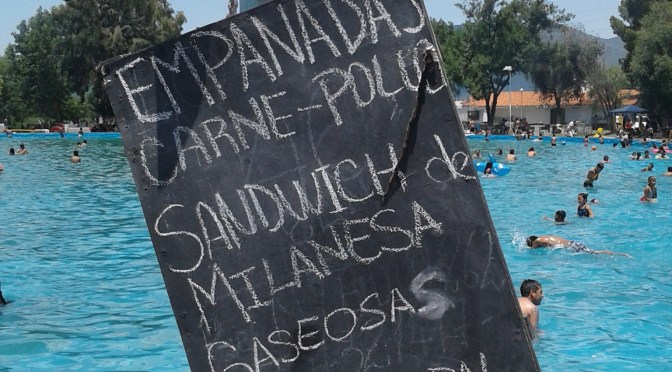
Wir richten uns auf ein unterhaltsames Wochenende ein und werden nicht enttäuscht. Von früh bis spät Pop Argentino mit voller Lautstärke, Gedränge auf allen Plätzen, qualmenden Parrillas und Lebensfreude bis zum Umfallen. Wir machen mit, geben uns der Fleischeslust hin, und sind glücklich und zufrieden:
JW/Clea
En plena Argentina!
El tiempo de navidad lo pasamos en Salta, al nor este de Argentina. Aquí los Andes están muy cerca y con ello la alegría de la gente por la vida y el festejo . Además es verano con temperaturas de 40 grados y vacaciones.
Todo el mundo hace vacaciones donde sino en el balneario Carlos Camena, el único lugar oficial donde camperos tienen un espacio en Salta. Así lo hicimos nosotros.
Nos hicimos la idea de un fin de semana entretenido y no fuimos decepcionados. Desde temprano en la mañanahasta la mañana siguiente pop argentino a todo volumen, multitudes en todo lado, humeantes parrillas y alegría por la vida hasta morir. Participamos y nos dimos a las carnes y estuvimos contentos igual:
JW/Clea
Right in the middle!
Christmas time we spent in Salta in the Norht-West of Argentina. The Andes a very close here and with them the joy of life and celebrations of all kinds. In addition it is summer and vacation time with the temperatures around 100 F.
Everybody is vacationing and – where else – exactly in the „Balneario Carlos Carmena“, the only official place in Salta, where campers are allowed.
We were prepared to have an “entertaining” weekend and – yes, we were not disappointed. From early in the morning until early in the next morning we were exposed to the beats of Argentine pop, a huge crowd of people in bathing costumes, smoking BBQs and the sheer joy of life ad nauseam. We join in and indulge in our carnal desires of beef and pork and are happy and content with everything.
JW/Clea
Salta ist eine mittlere Großstadt im Nordwesten von Argentinien. In Wikipedia steht, dass sie etwa eine halbe Million Einwohner hat:
Nach unserer Fahrt über den Jama-Pass wollen wir uns hier ein paar Tage erholen und bleiben auf dem einzigen Campingplatz der Stadt, dem „Balneario Carlos Xamena“:
Auch wenn es manchmal ziemlich „zugeht“ auf diesem Platz, fühlen wir uns sehr wohl.
Einen Tag vor Heiligabend besuchen wir La Casona del Molino (link zur Webseite). Wir sind begeistert: Hier kommen Laien- und Profiumsuiker zwanglos zusammen und machen argentinische Musik. Die beste Gruppe erhält den meisten Applaus und der Wirt bezahlt ihre Rechnung. Das motiviert alle, ihr Bestes zu geben. Und die meisten sind wirklich gut drauf:
Dass es hier auch tolles argentisches Bife de Chorizo (entspricht dem deutschen Rumpsteak) neben vielen anderen fleischlichen Köstlichkeiten) gibt, ist selbstverständlich.
Vegetarier finden natürlich auch etwas Leckeres mit Salat auf der Karte, aber deswegen geht wahrscheinlich niemand in die Casona de Molino.
Salta es una ciudad en el Nor-Oeste de Argentina. Wikipedia informa, que tiene alrededor de medio millón de habitantes.
Después de nuestro viaje por el Paso de Jama, descansamos un par de días en Salta y nos quedamos en el „Balneario Carlos Xamena“.
Aunque a veces hay mucho alboroto en el Carlos Xamena, nos sentimos a gusto aquí.
Un día antes de la Noche Buena visitamos La Casona del Molino (link zur Webseite). Estamos fascinados! Aquí llegan músicos aficionados y de profesión y hacen música folclórica argentina. El mejor grupo que recibe la ovación más grande no paga la cuenta. Esto motiva a todos a dar lo mejor de ellos. ..Y la mayoría son excelentes!
El hecho que en esta casa hay buena carne argentina está en este país sobre entendido. Las fotos hablan y la experiencia fue deliciosa.
Vegetarianos encuentran también delicias en el menú pero seguramente no es esa la razón para ir a la Casona del Molino.
JW/Clea
Salta is a mid-size town in the North-West of Argentina. In Wikipedia it says, that there are approximately ahalf million inhabitants.
After our trip over the Jama-Pass, we wanted to spend a couple of days there in order to relax and stayed in the „Balneario Carlos Xamena“:
Even though the campground is very busy sometimes, we like staying here a lot.
One night before Christmas Eve we visit the „Casona de Molino“ (link zur Webseite einbauen). We are enthusiastic: There are groups of (semi-) professional bands, which get together here and play Argentinian folk-music. The group, which receives the loudest and longest applause from the audience does not have to pay the bill. This is very motivating for every group and they all try their best. And most of them are really good.
It is quite natural, that you can get an excellent Argentinian „bife de chorizo“ (the equivalent of a rump steak) or other great meat-dishes in this restaurant.
Vegetarians will probably also find something tasty with salad on the menu, but this is certainly not why you visit the „Casona de Molino“.
JW/Clea
San Pedro de Atacama ist eine Reise wert, auch wenn das Zentrum des kleinen Ortes nur so wimmelt vor Touristen aus aller Welt:
Die Landschaft um San Pedro de Atacama ist überwältigend, z.B.: das Valle de la Luna:
Auch ein Ausflug zu den Termen von Putimara lohnt sich. In 3700 m Höhe ein warmes Bad in einer grünen Oase, zwischen Felswänden zu nehmen, hat schon seinen besonderen Reiz:
Die Fahrt zum Tatio und seinen Geysiren ist ziemlich anstrengend und beginnt um vier Uhr früh. Im Gegensatz zu einem ersten Besuch um die Jahrtausendwende, als wir in Santiago de Chile lebten, sind die Geysire zur Zeit leider kaum aktiv und das Wasser in den Pools ist lauwarm. Auf weit über 4000 m Höhe und bei kaltem Wind kein reines Vergnügen. Auf dem Weg nach unten gibt es Vikunjas und Flamingos zu sehen:
Wir sind jetzt schon zehn Tage in San Pedro de Atacama und genießen das wunderbare Klima. In der Casa Campestre haben wir einen angenehmen und ruhigen Standplatz gefunden.
Shanti fühlt sich besonders wohl, weil er hier mit den Hunden, die zum Haus gehören, den ganzen Tag herumtoben kann.
Gelegentlich betätigt sich Shanti sogar als Lebensretter:
Die „normalen“ Einwohner dieses Ortes leben natürlich nicht so komfortable wie die Touristen und wie wir. Auf dem Weg zu den landschaftlichen Sehenswürdigkeiten kommen wir vorbei an den Siedlungen am Rande der Stadt, in denen z.B. das Personal der vielen Restaurants und Hotels wohnt:
Und trotzdem: Auch hier wird gefeiert. Dabei ist der Unterschied zwischen Karneval und religiöser Prozession fließend:
Morgen soll es nach Argentinien weitergehen. Auf dem Weg dorthin wollen wir noch eine Lagune besuchen, in der es Flamingos, Lamas und Vikunjas geben soll. – Wir sind gespannt.
Vor uns liegen über 500 km bis Salta in Argentinien. Eine Bergstrecke mit vier oder fünf Passhöhen zwischen 4000 und 5000 m Höhe. Uns ist ein bisschen mulmig bei dem Gedanken. Aber Esperanza wird auch das schaffen.
JW/Clea
Puro turismo – y a pesar de eso …
Un viaje a San pedro de Atacama vale la pena, aunque el centro del lugar es pequeño y lleno de turistas de todo el mundo:
El paisaje alrededor de Atacama es impresionante… por ejemplo El valle de la Luna
Una excursión a las Termas de Puritama también vale la pena. Meterse en agua caliente a una altura de 3700 metros tiene un encanto especial.
El viaje al Tatio y sus géiseres es bastante agotador y empieza a las cuatro de la mañana. En contraste a una primera visita que hicimos durante el cambio del milenio, cuando vivíamos en Santiago de Chile, los famosos géiseres no son muy activos hoy en día y las aguas te la piscina son solamente tibias. A una altura de más de 4000 metros y con el viento frío no resultan placenteras
Ya estamos diez días en San Pedro de Atacama y disfrutamos del clima maravilloso. En la Casa Campestre hemos encontrado un lugar confortable y tranquilo.
Shanti también se siente muy bien aquí, porque el puede jugar con los perros de la casa todo el día.
De vez en cuando Shanti inclusive trabaja como rescatista.
Los habitantes „normales“ de este sitio viven no tan confortablemente como los turistas. En el camino a los paisajes atractivos alrededor del pueblo pasamos por las zonas de los alrededores de San Pedro de Atacama
Y a pesar de eso: Acá también hay fiestas. La diferencia entre carnaval y una procesión religiosa es mínima.
Mañana queremos viajar a Argentina. En el camino queremos visitar una laguna, donde hay flamencos, Llamas y vicuñas. –Estaremos atentos.
Delante de nosotros hay 500 kilómetros hasta Salta en Argentina. Un viaje a través de cuatro o cinco pasos entre 4000 y 5000 metros de altura. Nos ponemos un poco inquietos pensado en esto. Pero Esperanza va a hacerlo también.
JW/Clea
It’s pure tourism – but still …
San Pedro de Atacama is worth a trip, even if the center oft he small place is teeming with tourists from all over the world:
The landscape around San Pedro de Atacama is overwhelming, for example the Valle de la Luna
An excursion to the hot springs of Putirama is also worth an effort. It is certainly a special feeling to take a hot bath in a green oasis, between high rising walls of rocks in an altitude of 13,000 feet.
The tour up to the Tatio and its geysers is exhausting and begins at 4 o’clock in the morning. In contrast to our first visit around the change of the millennium, when we were living in Santiago de Chile, the geysers are not very active these days and the water in the pool is only lukewarm. If you are well over 13,000 feet high and a cold wind is blowing, this is not really funny. – On the way down Vicuñas and flamingos can be seen:
We have already been ten days in San Pedro de Atacama and we are enjoying the wonderful weather. In the Casa Campestre we have found a comfortable and quiet place.
Shanti likes the Casa Campestre very much too, because he can play around with the dogs of this place all day long.
Sometimes Shanti even works as a coastguard.
The “regular“ inhabitants of San Pedro de Atacama do not live as comfortably as the tourists or as we do. On the way to the sights of the area we drive through the outskirts, where the poorer people live, for example the waiters of the many restaurants:
But in spite of their living conditions the people love celebrating. The difference between carnival and a religious procession is flowing.
Tomorrow we will probably travel to Argentina. On the way there we want to visit a lagoon, where flamingos, lamas and vicunas can be seen. – We are looking forward to it.
It will be a little more than 300 miles to Salta in Argentina. We are expecting a mountainous road with four or five passes between 13,000 and 16,000 feet. We feel a little intimidated. But Esperanza will make it again.
JW/Clea
Vor ein paar Wochen haben wir über unsere Nacht und unser Erwachen in Pisagua berichtet. Damals wussten wir noch nicht, was wir dieser Tage zufällig von einem chilenischen Freund erfahren haben:
In den zwanziger Jahren des letzten Jahrhunderts hat der damalige chilenische Präsident hier ein Konzentrationslager für Homosexuelle eingerichtet. Umgeben von unüberwindlichen Sandbergen auf allen Seiten am Rande des unwirtlichen und kalten Pazifiks war dies der geeignete Ort, diese Menschen vom Rest der chilenischen Gesellschaft zu isolieren.
Während des zweiten Weltkriegs wurden hier Angehörige feindlicher Nationen interniert. Präsident Gabriel Gonzalez Videla nutzte die Einrichtungen Ende der vierziger Jahre um unliebsame Kommunisten wegzuschließen und 1948 übernahm der damalige Kapitän der chilenischen Armee, Agosto Pinochet, das Kommando über das Lager.
Die einzigartige geografische Lage von Pisagua wussten Pinochet und seine Schergen auch zu nutzen, als sie sich 1973 an die Macht putschten und den sozialistischen Präsidenten Salvador Allende stürzten. Das Konzentrationslager für politische Gefangene wurde auch als Foltergefängnis „genutzt“ und zahlreiche Häftlinge wurden hier umgebracht und in Massengräbern „entsorgt“.
Bis heute wird behauptet, dass viele von ihnen lebend, an Ketten gefesselt, aus Flugzeugen ins Meer geworfen wurden. Ein Thema, mit dem sich auch der berühmte chilenische Filmemacher Patricio Guzmán in seinem preisgekrönten Dokumentarfilm El botón de Nácar auseinandersetzt.
Ein bedrückender Gedanke, eine bedrückende Atmosphäre. Kein Wunder, dass uns Pisagua wie das Ende der Welt, das Ende allen Lebens erschien, auch wenn wir damals noch nicht wussten, welche Untaten hier stattgefunden haben.
JW/Clea
Pisagua
Hace un par de semanas contamos de nuestro amanecer en Pisagua. Ahí todavía no asociábamos este nombre y lugar con algunos incidentes de la historia chilena. Nos enteramos por un chileno mismo en estos días.
En los años 20 del siglo pasado el presidente chileno construyó en este lugar un campo de concentración para homosexuales. Rodeados de cerros de arenas intocables por los vientos al borde del frío Océano Pacífico eran aisladas estas personas del resto de la sociedad chilena.
Durante la Segunda Guerra Mundial ciudadanos de naciones enemigas fueron detenidos ahí. El presidente Gabriel Gonzalez Videla usó la institución a fines de los años cuarenta para encerrar a comunistas desagradables y en el año 1948 el capitán de las fuerzas armadas de Chile Agosto Pinochet asumió el mando del campo.
La geografía especial de Pisagua fue aprovechada muy bien por Pinochet y sus esbirros. Cuando llegaron al poder en el año 1973 derrocando a Salvador Allende con un golpe militar establecieron un campo de concentración para prisioneros políticos y una celda de tortura donde eran asesinados los prisioneros, echados a fosas comunes o al mar.
Hasta ahora se afirma que muchos de ellos eran atados a cadenas y tirados al mar vivos. El famoso documentalista chilena Patricio Guzmán (link) se dedica a este tema en sus lúcida y brillante documental El botón de Nácar.
Un pensamiento opresor, una atmósfera asfixiante. No es de sorprender que Pisagua nos pareciera el fin del mundo, fin de la vida, aunque todavía no conectamos en ese momento ese lugar con el escenario de horrorosos crímenes.
JW/Clea
Pisagua
A couple of weeks ago, we reported about our night and awaking in Pisagua. At that time, we did not know, what we accidentally heard from a Chilean friend these days.
In the 20ies of the last century the Chilean president had a concentration camp for homosexuals built here. Surrounded by huge sand dunes on all sides and by the stormy and cold Pacific this was the “best” place for isolating these people from the Chilean society.
During World War II citizens from enemy nations were detained here. At the end of the 40ies president Gabriel Gonzalez Videla used the camp for locking away communists, and in 1948 the then captain oft he Chilean Army, Agosto Pinochet, took command of the camp.
The unique geographical location of Pisagua was also used by Pinochet and his henchmen, after they had taken power in a coup d’état in 1973 and subverted the socialist president Salvador Allende. The concentration camp for political prisoners was also used for torturing and many inmates were killed and „deposed“ in mass graves or the sea.
Until today there are rumors, that many of them were chained and dropped into the sea alive. It is a subject, which the famous filmmaker Patricio Guzmán has dealt with in his award-winning documentar El botón de Nácar:
What an oppressive idea, an oppressive atmosphere. No wonder, that we thought, we had reached the end oft he world, the end of life, when we were in Pisagua, even though we did not yet know, what terrible crimes had taken place here.
JW/CLea
Seit gut vierzehn Tagen sind wir an der Playa Blanca, ein paar Kilometer südlich von Iquique.
Wir stehen an einem schönen Sandstrand, unterbrochen von felsigen Partien, mit Blick auf die Silhouette von Iquique. Hinter uns die einfachen Strandhäuser der „Piraten“:
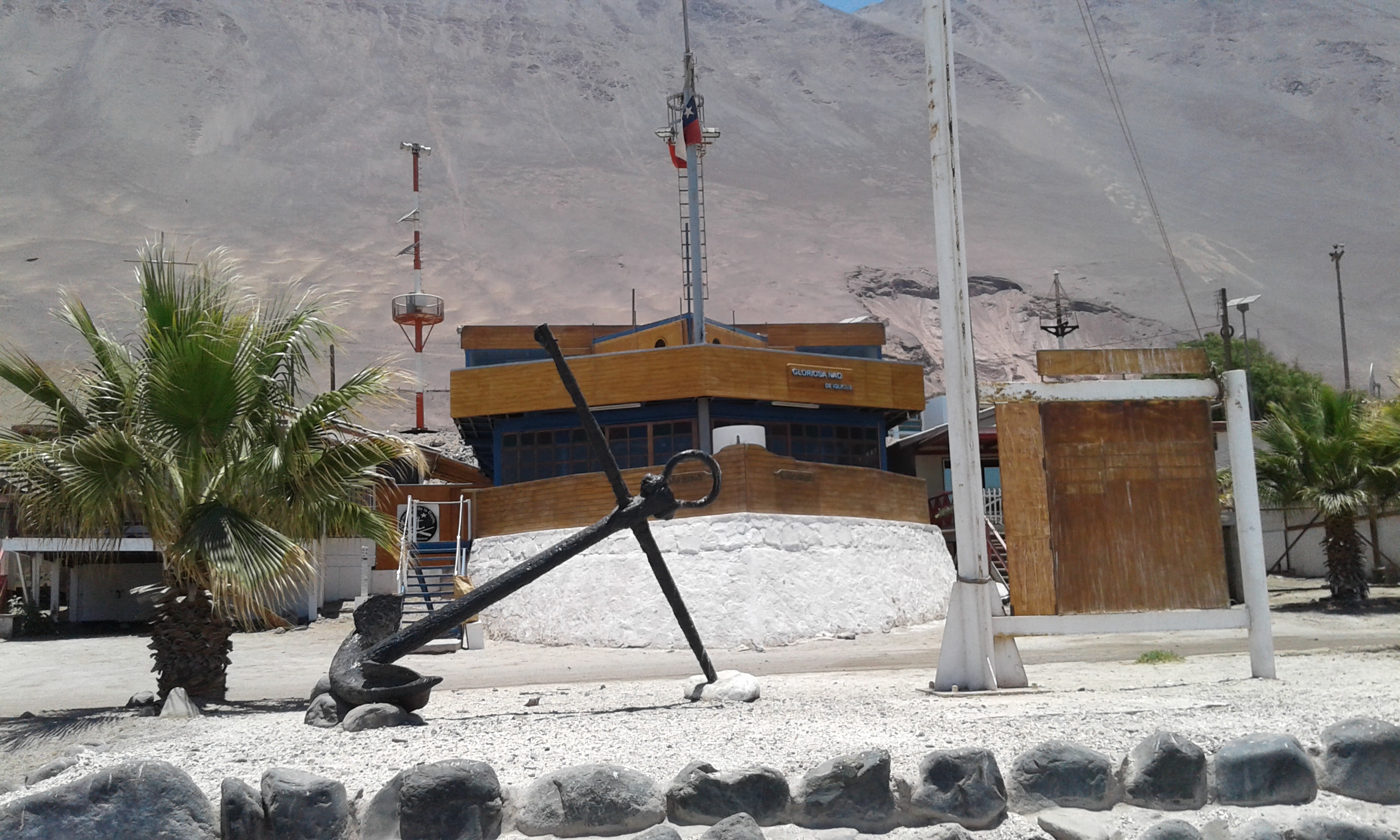
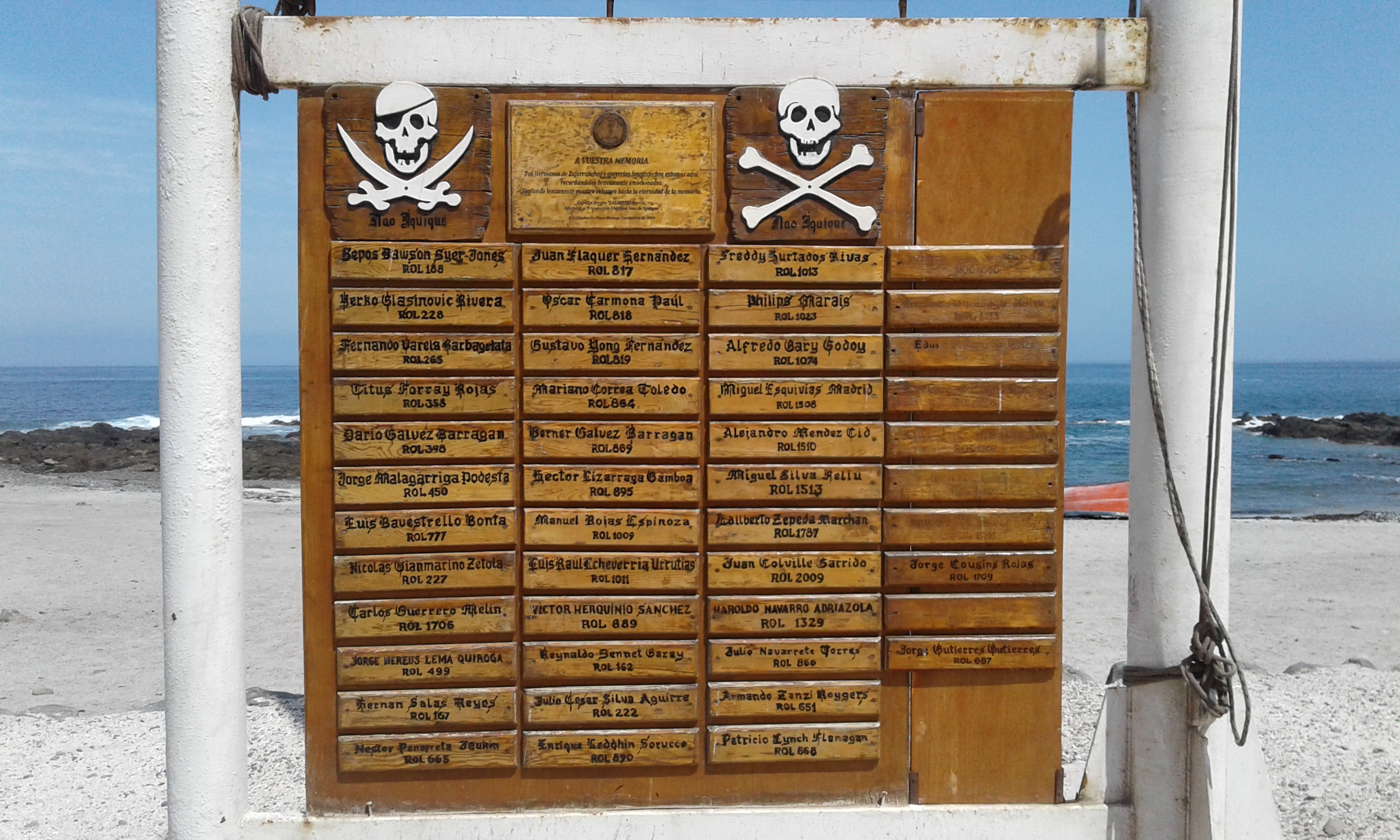
Das sind Leute, die das Meer lieben. Die Wochenenden verbringen sie oft am Strand, ein paar wohnen auch dauerhaft hier und hin und wieder treffen sie sich zu einem zafarrancho. Da wird dann lang und ausgiebig gefeiert.
Uns haben sie gleich am ersten Tag „adoptiert“ und zu einem Abendessen mit viel gutem chilenischen Wein, Musik, Anekdoten aus dem Leben und viel Lachen eingeladen.
So ähnlich geht das dann zwei Wochen weiter zwischen Meer, Möwen, Wein und Nachbarschaftsgesprächen. Wir erfahren viel über Chile und das Leben hier in Iquique. Hin und wieder fahren wir auch in die Stadt, um einzukaufen und uns das Zentrum von Iquique anzuschauen. Vor allem die Häuser und Bürgersteige, die früher aus alten Schiffsplanken gebaut wurden und gerade restauriert werden, sind sehenswert.
Iquique ist schöner und hat viel mehr zu bieten, als wir erwartet hatten. Durch die Beschreibung von anderen Reisenden waren wir ein wenig voreingenommen. Mag schon sein, dass durch den Freihafen, der bei manchen Besuchern eine Art von Kaufrausch auslöst, auch die Versuchung für die Gauner wächst, den einen oder anderen Camper zu überfallen (so steht es jedenfalls in iOverlander), – aber wir haben davon nichts mitbekommen, nur die Freundlichkeit der Chilenen. Clemen singt: „Du wirst schon sehen, wie sie in Chile einen Freund lieben, wenn er ein Fremder ist.“ – Vielleicht haben wir das alles ja auch schützenden Mantel der „Virgen de Guadalupe“ zu verdanken.
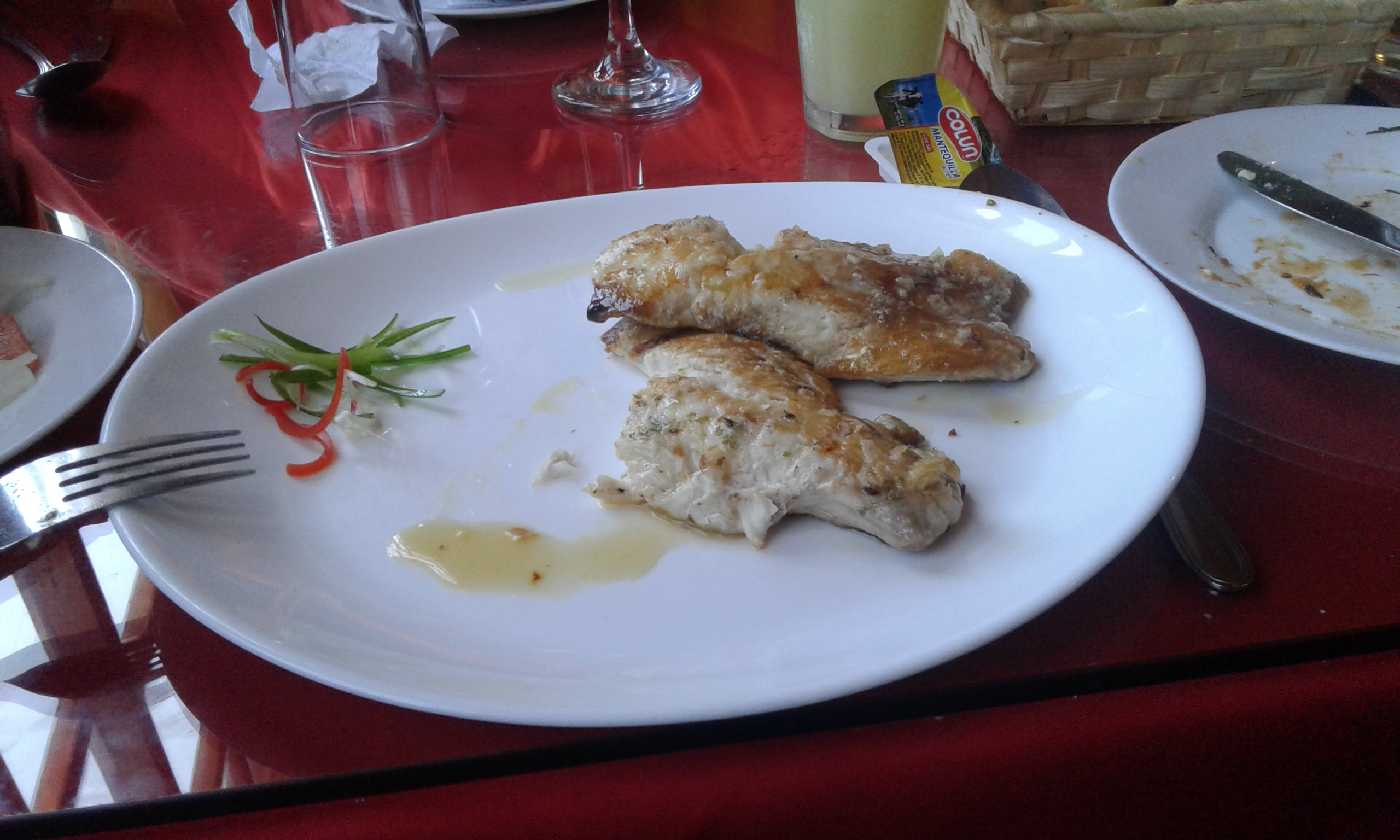
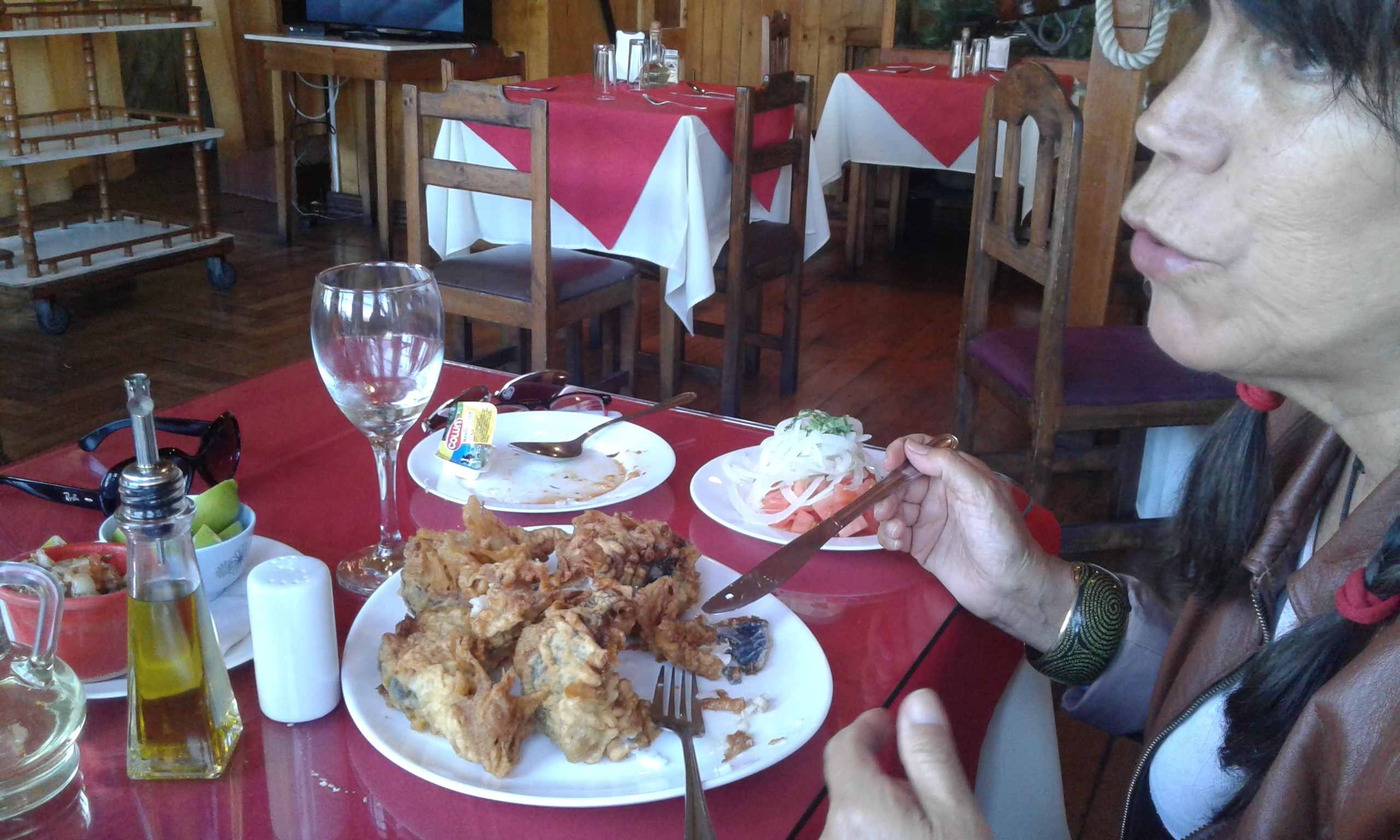
Natürlich kann man in Iquique und den kleineren Fischerorten im Süden sehr gut Fisch essen. Das tun wir dann auch ein paarmal. Vor allem das „Neptuno“ in Iquique hat ein ganz besonderes Interieur:
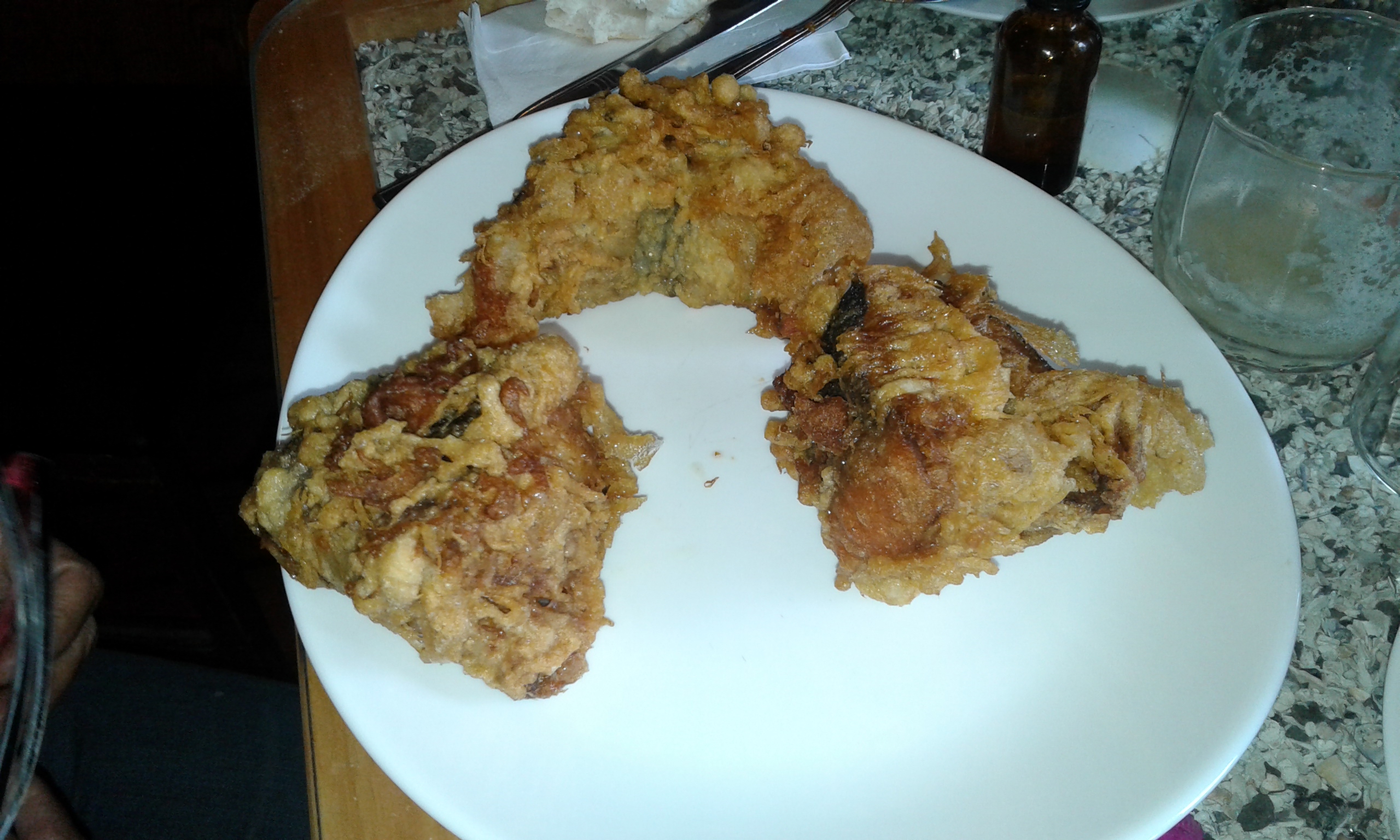
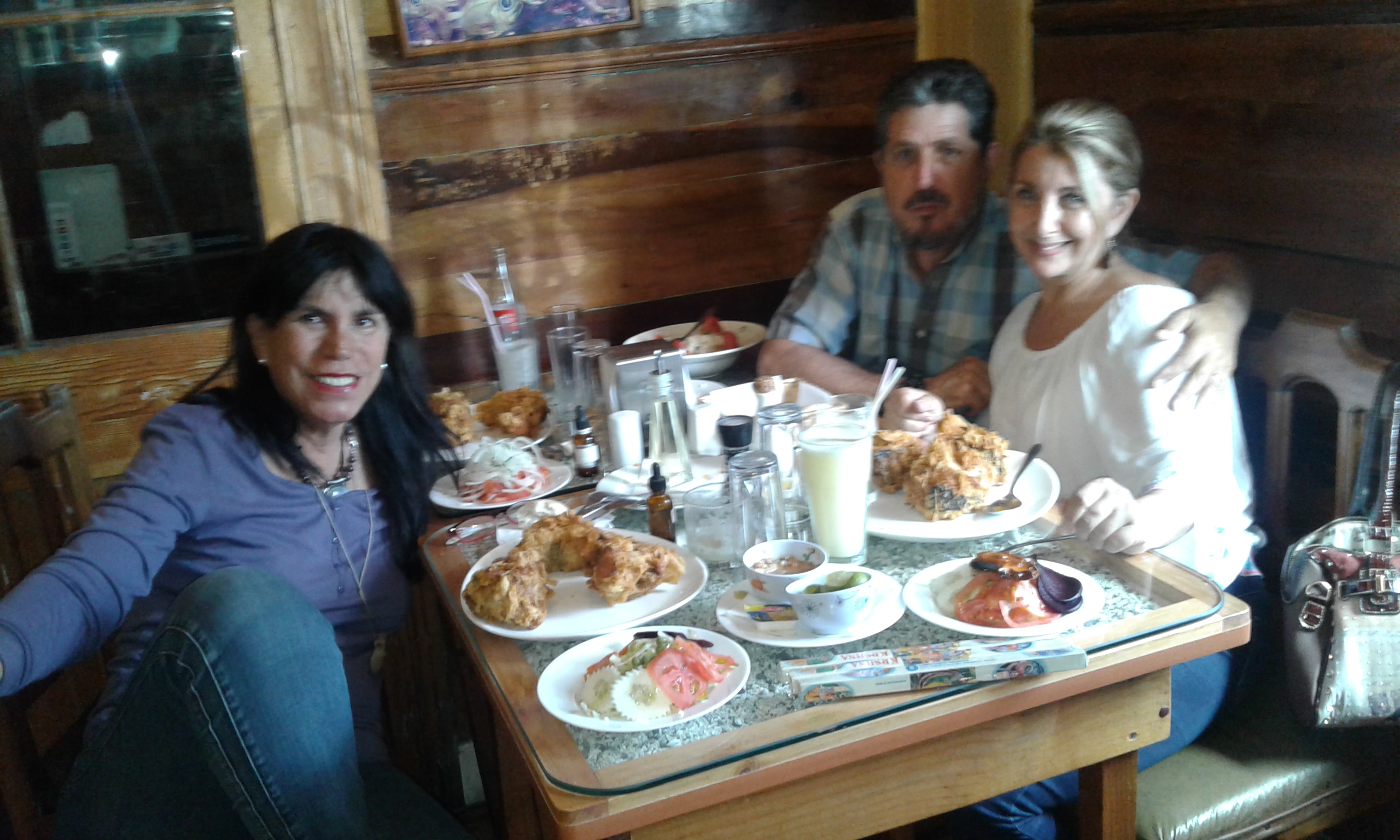
Und (fast) jeden Morgen machen wir einen Strandspaziergang „zu den Möwen“. Dort gibt es niemanden außer uns und den Hunden. Ein wunderschöner Platz zum Meditieren oder zum Yoga machen, nicht nur für uns:
Auch wenn es noch so schön am der Play Blanca ist, irgendwann müssen wir weiter. Noch trennen uns über 5000 km von Tierra de Fuego. Wir rechnen mit mindestens zwei Monaten für die Fahrt bis Ushuaia.
JW/Clea
Donde los piratas
Desde hace más de 2 semanas ya estamos en Playa Blanca, un par de kilómetros al sur de Iquique.
Hemos estacionado nuestra Esperanza al borde de una playa de arena muy linda, con partes de roca y vemos la silueta de Iquique en el fondo. Detrás de nosotros se encuentran las casas de playa de los “piratas”.
Quienes son los piratas? Es gente, adoradora del mar que tienen sus encuentros de cuando en vez que se llaman zafarranchos. Pasan los fines de semana en la playa, otros son permanentes. Nos han adoptado y nosotros a ellos.
Nos conectamos rápidamente el primer día. Estamos en una cena liviana con mucho vino chileno delicioso, música y anécdotas de vida y risas.
Más o menos así ha pasado el tiempo acá entre gaviotas, mar, piratas, vino y conversas de vecinos. Nos cuentan mucho de Chile y la vida acá en Iquique. De vez en cuando vamos a Iquique para hacer compras y conocer el centro histórico de la ciudad. Llaman la atención especialmente las casas y veredas en madera que fueran construidas hace tiempo de barcos hundidos. Muchas de ellas reconstruidas hoy. Iquique es en ese sentido una sorpresa agradable.
Por algunos reportes de otros viajeros andábamos un poco preocupado. Es posible, que la Zona Franca de Iquique incite un tipo de consumo exagerado en algunos viajeros y también la codicia de los malos piratas, que a veces atracan a camperos (así dicen por lo menos en iOverlander) – pero nosotros no hemos experimentado nada en ese sentido, solamente el cariño de los chilenos. Clemen canta: ¨ Y verás cómo quieren en Chile al amigo cuando es forastero.“ – Quizás también es obra del manto protector de la „Virgen de Guadalupe“.
Claro que se puede comer muy buen pescado en Iquique y en los pequeños sitios en el sur de la ciudad. Lo hacemos un par de veces. Especialmente el „Neptuno“ en Iquique tiene un interior muy acogedor:
Y casi cada mañana hacemos un paseo por la playa hasta donde las gaviotas. No hay nadie allá… sólo nosotros y los perros, que nos acompañan. Es un sitio muy lindo para meditar y hacer Yoga, no solamente para nosotros.
Aunque nos gusta mucho en Playa Blanca, tenemos que partir. Todavía nos separan más de 5000 km a Tierra de Fuego. Contamos con dos meses más por lo menos para el viaje hasta Ushuaia, la parte más Sur del continente sudamericano.
JW/Clea
Where the pirates live
We have been at Playa Blanca, a couple of miles south of Iquique for over 2 weeks now.
We have found a place at a beautiful sand beach with some rocky parts and a great view of the Iquique in the background. Behind us there is a row of beach houses, where “The Pirates” live.
These people love the ocean. They often spend the weekends in their beach houses. Some of them even live here constantly and from time to time they meet for a zafarrancho, an event with lots of wine and food.
The pirates „adopted“ us right on the first day and invited us for a great snack with lots of good Chilean wine, music, anecdotes of real life and much laughing.
And now we have been here for over two weeks between seagulls, the ocean, wine and neighborhood conversations. We learn a lot about Chile and life in Iquique. From time to time we drive to the center of the city to go shopping and do some sightseeing. The houses and sidewalks, which were made of wood from shipwrecks in former times and which are being restored right now, are really worth seeing.
Iquique is much nicer and has much more to offer than we had expected. Some reports of other travelers (for example on iOverlander) had caused certain concerns with us. Maybe that the free harbor area sometimes really causes a kind of consumer frenzy and also incites the greed of the crooks so that some campers were actually mugged, – but we had no such experiences, instead we only met extremely friendly Chileans. Clemen even sang: “You will see, how the Chileans will love a friend, if he is a stranger.” – And maybe we are also still protected by the “Virgen de la Guadalupe”
Of course there are some restaurants in Iquique and the small places south of it, where you can eat excellent fish. And we do that a couple of times. Mainly the “Neptuno” in Iquique has a very special interior.
And almost every morning we walk along the beach to where the seagulls are. There is (almost) nobody there except our dogs and us. It is a great place for mediation and some Yoga, not only fort he two of us:
Even though Playa Blanca is a very beautiful place, sometime we have to continue our trip. There are still more than 3000 miles, between here and Tierra de Fuego. We count with two months of traveling time at least for the trip to Ushuaia.
JW/Clea
Seit ein paar Tagen sind wir in Mamiña. Ganz oben über dem Ort, ziemlich dicht am Himmel, liegt der Friedhof. Dort ist es sehr, sehr still, nur der Wind singt zwischen der Grabhügeln und bewegt die künstlichen Blumen ein wenig:
Mamiña liegt im Norden der chilenischen Anden, ca. 2700 m hoch. Ein einsamer Ort mit wunderschönen Sonnenuntergängen. Bedrückend sind die Reste von eingestürzten Häusern von den letzten Erdbeben:
Wir sind hier, weil es hier heiße Thermalquellen gibt. Auch unser Hotel hat ein schönes Schwimmbad mit Thermalwasser, ca 38 Grad warm. Wir genießen den Pool jeden Tag und erholen uns von den Strapazen der ersten Etappe unserer Reise:
Eigentlich wollten wir nur ein, zwei Tage bleiben. Aber jetzt beginnt schon der vierte Tag und wer weiß, vielleicht bleiben wir noch länger. Die meiste Zeit sind wir die einzigen Gäste hier oben im Hotel La Coruña.
Die Nächte sind still, sehr still in Mamiña. Nur selten begegnet uns ein Einwohner:
Dafür gibt es viele Hunde, die durch den Ort streifen. Alle freundlich, liebebedürftig, anhänglich. Am liebsten würde wir sie alle mitnehmen:
Auch in der Polizeistation ist alles ruhig und friedlich und die Polizisten scheinen zu schlafen:
Trotz – oder besser wegen der Einsamkeit hier oben fühlen uns wir sehr wohl. Und das Thermalwasser hilft uns, die schwere Erkältung, die wir aus der Höhe von Huancayo mitgebracht haben, allmählich zu überwinden.
JW/Clea
Muy cerca al cielo
Ya estamos en Mamiña desde hace unos días. Arriba del pueblo, muy cerca al cielo, allí esta el cementerio. Allí está todo muy, muy silencioso. Solamente el viento sopla un poquito entre las tumbas y las flores artificiales.
Mamiña está en el extremo norte de los Andes Chilenos, aproximadamente 2750 metros de altura. Es un sitio bastante aislado con atardeceres muy lindos. Los restos de casas derrumbadas por los últimos terremotos deprimen un poco.
Las aguas termales nos atrajeron. .El hotel donde aparcamos también tiene una piscina muy linda con aguas termales con 38 grados. Disfrutamos la piscina cada día y nos recuperamos de la primera etapa del viaje.
Al principio solamente quisimos quedarnos acá un día o dos. Pero ahora el cuarto día ya ha empezado y – quien sabe – quizás nos quedamos unos días más. Casi todo el tiempo somos los únicos huéspedes.
Las noches son muy, muy tranquilas en Mamiña. Apenas encontramos un habitante en las calles.
Por otro lado hay bastantes perros, que viven en la calle. Todos son muy sociables, piden cariño y quieren acompañarnos.
Inclusive en la estación de policía todo está muy tranquilo y los policías parecen dormir.
A pesar – o mejor dicho – por la soledad acá arriba nos sentimos muy bien. Y las aguas termales nos ayudan a recuperarnos del fuerte resfrío traído de las alturas huancaínas.
JW/Clea
Very close to heaven
We have been in Mamiña for a couple of days now. Very high up above the small town, close to heaven, there is the cemetery. It is very, very quiet here. Only the wind blows a little bit between the tombstones and the artificial flowers.
Mamiña lies in the northern Andes of Chile, almost 9000 feet high. It is a very lonely place with wonderful sunsets. The relics of houses, which were destroyed by the last earthquakes, are depressing.
We are here because of the hot thermal springs. Our hotel has a wonderful pool and the water is about 100 F hot. We enjoy the pool every day and recover from the stress of the first part of our trip:
Originally we only wanted to stay here for one or two days. But now the fourth day has already begun and who knows, maybe we will stay here some more days. Most oft he time we are the only guests in the Hotel La Coruña.
The nights are very, very quiet. Hardly do we meet any people in the streets.
But there are lots of dogs everywhere. All of them very friendly, craving for love and willing to follow you everywhere. We would love to take them all with us.
Even the police station looks peaceful and the policemen seem to be sleeping.
In spite of he loneliness up here in the Andes – or maybe because of it – we feel very well in Mamiña. And the hot thermal waters help us to slowly but gradually overcome the severe cold, which we have brought with us from the heights of Huancayo.
JW/Clea
JW/Clea
wir leben noch. Nach etwas mehr als sieben Wochen in der Nähe von Huancayo in der Cordillera Central de los Andes haben wir Peru am 22. Oktober verlassen; einen Tag bevor unsere Gehmigung für die vorübergehende Einfuhr unseres Wohnmobils nach Peru erloschen ist.
Zum Glück hatten wir auf den letzten Kilometern keine Panne o.Ä. und konnten so Peru ohne Probleme verlassen. Nun sind wir schon wieder eine Woche in Chile und erholen uns so langsam von der intensiven Zeit mit den Kindern und ihren Kümmernissen in der Albergue von San Pedro de Saño.
Doch davon ausführlich in den nächsten Blogbeiträgen. Unsere langes Schweigen hat hauptsächlich damit zu tun, dass wir in den drei Wochen, die wir zunächst in Lima verbracht haben, ganz und gar mit Familie beschäftigt waren und außerdem versucht haben, unsere Einfuhrgenehmigung für das Auto auf 180 Tage zu verlängern, – was uns aber nicht gelungen ist. Und danach, in der Albergue, waren wir von der Kommunikation mit dem Rest der Welt weitgehend abgeschnitten.
Wir hatten dort oben zwar eine Internetverbindung (zunächst mit 2 MB, später sogar mit 6 MB), aber das hat nur für einen ausreichenden „Download“ gesorgt. Der „Upload“ geht in ganz Peru nur über ADSL und ist damit sehr, sehr, sehr langsam. Eine Zeitlang habe ich versucht, ein paar Videos hochzuladen, aber das hat buchstäblich Tage gedauert. Dann habe ich die Sache – vorübergehend – ganz eingestellt.
Einige Freunde haben sich Gedanken über uns gemacht; wir entschuldigen uns für diese Situation und danken für eure Fürsorge und euer Interesse.
Nun hoffen wir, dass das mit dem Internet in Chile besser klappt.
JW/Clea
Queridos amigos en todo el mundo,
Aún vivimos. Después de un poco más de siete semanas cerca de Hunacayo en la Cordillera Central de los Andes peruanos salimos de Perú el día 22 de Octubre; un día antes de que caduque nuestro permiso temporal de importación de Esperanza, nuestra casa rodante.
Afortunadamente no tuvimos ningún pinchazo o algo similar en los últimos kilómetros en el Sur del país pudiendo atravesar la frontera a tiempo y sin ningún problema.
Ya estamos en Chile desde hace más de una semana y nos recuperamos poco a poco de este tiempo tan intenso con las niñas y sus preocupaciones en el albergue de San Pedro de Saño. Más sobre este tema en nuestros próximos posts en nuestro blog.
Nuestro silencio tan largo tiene que ver en primer lugar con el hecho que pasamos los tres primeras semanas en Lima con nuestra familia, tratando de prorrogar el plazo dado para el auto hasta 180 días, cosa que no logramos. Después, en el albergue, estuvimos más o menos incomunicados con el resto del mundo. Sí tuvimos una conexión al internet (al principio a 2 MB; después inclusive a 6 MB), pero eso fue solamente suficiente para un „download“ suficiente . El „Upload“ en todo el Perú solamente funciona a través de ADSL y por eso es muy, muy lento. Un tiempito yo he tratado de subir unos videos a pesar de eso, pero me tomó literalmente días. Por eso decidí rendirme finalmente y esperar hasta que tengamos una conexión mejor, esperemos por acá, en Chile.
Algunos amigos se preocuparon por nosotros. Les pedimos disculpas por este silencio y les agradecemos interés y cariño.
Esperemos, que lo del internet funcione mejor acá en Chile.
JW/Clea
Dear friends all over the world,
we are still alive. After a little more than seven weeks near Huancayo in la cordillera central de los Andes we left Peru on October 22; one day exactly before our permit for the temporary import of our car was to expire.
Fortunately we had no breakdown or anything more serious on the last stretches in Peru and were able to leave the country without any problems. Now we have been in Chile for over week already and we are slowly recovering from the the intense time with the children and their worries in the „albergue“ de San Pedro de Saño. More about that in our next posts.
Our long silence has mainly got to do with the fact, that we spent the first three weeks in Lima with Clemen’s (and my!) family and at the same time tried hard to get an extension to 180 days for the import permit for our car, – which we did not in the end. And after that in San Pedro de Saño we had been almost totally cut off from any kind of communication wit the rest oft he world.
Even though we had a working internet connection in Saño (which was 2 MB fast at the beginning and later we improved it to 6MB), but that was only enough for a sufficient download speed. The upload was extremely slow, because the whole internet in Peru only works over ADSL. For some time I tried to upload videos anyway, but it literally took days to upload even short videos. This is why I finally decided to give up on it and wait until we would have a reasonable connection again, presumably here in Chile.
Some friends were even worried about us and we apologize for the situation and our silence. Thank you for your concern and interest in our wellbeing.
Let’s hope, the connection in Chile will be better again.
JW/Clea
Die Nazca-Linien in Peru kennt (fast) jeder, – zumindest vom Hören-Sagen oder aus Dokumentarfilmen.
Die Geoglifos im Norden von Chile sind viel weniger bekannt. Mag sein, dass das auch an Erich von Däniken liegt, der die Linien in Nazca ja als Landeplätze für Außerirdische interpretierte und damit (auch) für ihre Bekanntheit sorgte.
Vielleicht liegt es auch einfach daran, dass die dargestellten Symbole und Lebewesen in Chile weniger differenziert und weniger spektakulär sind als die in Nazca. Dennoch, auch diese Zeichen in der Atacama-Wüste sind beeindruckend und bis heute ist ihre Bedeutung nicht eindeutig geklärt. Möglicherweise waren es Wegweiser für Nomaden, die durch die Wüste zogen.
Wer an den Sand- und Staubbergen entlang läuft, auf deren Flanken diese Zeichen vor Jahrhunderten eingeprägt wurden, wird sich unweigerlich bewusst, wie klein und unbedeutend wir Menschen in diesem Kosmos sind:
Las líneas de Nazca las conoce casi cualquiera de escuchadas, en vivo o de películas documentales.
Los Geoglifos de Chile son menos conocidos, a lo mejor porque Erich von Däniken afirmara que las líneas de Nazca eran los aeropuertos de extra terrestres.
Otra explicación podría ser que los símbolos en Chile son menos diferenciados y espectaculares que los de Nazca. Sin embargo estos geoglifos en el desierto de Atacama son impresionantes y hasta la fecha no se ha encontrado una explicación clara de su existencia. Al parecer marcaban el camino para grupos nómades que caminaban por el desierto.
Quien pasea bordeando estos geoglifos que fueran marcados hace millones de años en las lomas de la montaña toma conciencia de lo pequeño que como humanos somos en este inmenso universo.
JW/Clea
(Almost) everybody has heard of or already seen the Nazca-lines in Peru live or on TV.
The Geoglifos in the North of Chile are much less known. Maybe this is due to Erich von Däniken, who has interpreted the Lines of Nazca as landing sites for aliens from outer space. Maybe it is only due to the fact that the symbols and living beings, which are depicted in Chile are less differentiate and less spectacular than those in Nazca.
Whatever the reason, the symbols in the Atacama-Desert are also very impressive and until today it is not really clear, why they were created. It is possible that they were signs for nomads on their way through the desert.
Who walks along the dusty mountains, on whose slopes these symbols were embedded centuries ago, will without doubt become aware of the insignificance of human life in this cosmos.
JW/Clea
Der Tamarugal wächst nur hier in der Atacama-Wüste, der trockensten Wüste der Welt.
Er wird ca. fünfzehn Meter hoch und seine Wurzeln reichen dreimal so tief in den staubtrockenen Boden, wo sie Grundwasser finden, das aus den Anden kommt. Ein beeindruckender, schattenspendender Baum inmitten einer lebensfeindlichen Umgebung.
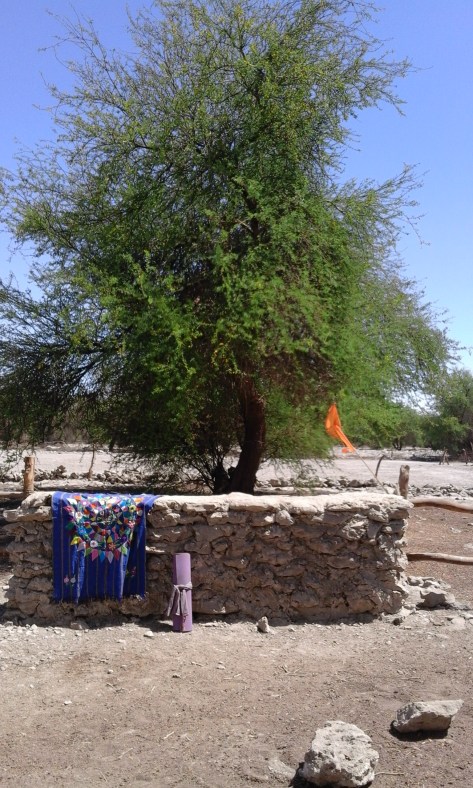
In den dreißiger Jahren des letzten Jahrhunderts hat ein reicher chilenischer Unternehmer erkannt, dass der Baum gefährdet ist und mit seiner Wiederaufforstung begonnen. Heute steht dieser Wald – mitten in der Atacama – unter Naturschutz und dort gibt es auch einen staatlichen Campingplatz:
Der Ort gefällt uns sehr gut; außerdem brauchen wir die totale Einsamkeit und den Frieden in diesem Naturreservat, um uns von den Strapazen in San Pedro de Saño zu erholen.
Reserva de Tamarugal
El tamarugal solamente crece aquí en el desierto de Atacama, el desierto más árido del mundo
Crece aprox. 15 metros de altura y sus raíces se estiran en tres veces su tamaño tan profundamente para llegar a la fuente de agua. Un árbol impresionante, dispensador de sombra en medio de un espacio inhóspito.
En los años 30 del siglo pasado un empresario chileno observó que el tamarugal corría peligro de extinguirse. Fue así que empezó con su reforestación. Hoy está este bosque en medio de la total sequedad, bajo protección natural. Ahí hay un camping para nosotros.
Nos gusta tanto y necesitamos tanto de esa paz y soledad después de todos los esfuerzos en San Pedro de Saño. Vamos a quedarnos acá un tiempito.
Nature Reserve of Tamarugal
The tamarugal is a tree, which exclusively grows in the Atacama Desert, the driest desert in the world.
The tamarugal reaches a height of about 50 feet and its roots dig into the dry and very hard desert ground three times the size of the tree itself, until they find subterranean water, which comes rom the Andes. It is an impressive tree, which offers plenty of shade in a surrounding absolutely hostile to life.
In the 30ies oft he last century a rich Chilean businessman recognized, that the tree was in danger of extinction and started reforesting the tamarugal. Today the forest is under protection and the Reserva de Tamarugal offers a state-run campground:
We love this place very much and we urgently need the peace and tranquility of this nature reserve in order to recover from the stress of our time in San Pedro de Saño. We will stay here for a while.
JW/Clea
Zwischen Arica und Iquique machen wir eine Nacht Station in Pisagua. Wir kommen spät in der Nacht an und finden ein ruhiges Plätzchen vor dem alten Feuerwehrhaus.
Am nächsten Morgen, kurz nach Sonnenaufgang, fragen wir uns: „Sind wir schon angekommen, am Ende der Welt?
JW/Clea
Entre Arica e Iquique nos quedamos una noche en Pisagua. Llegamos tarde en la noche y encontramos un sitio tranquilo frente a los bomberos.
Al día siguiente, después de la salida del sol, nos preguntamos: „¿Ya hemos llegado al fin del mundo?“
JW/Clea
JW/Clea
Between Arica and Iquique we stay overnight in a place called Pisagua. We arrive late at night and find a quiet place in front of the fire station.
The next morning, after the sun has risen, we ask ourselves: “Have we already arrived at the end of the world?”
JW/Clea
Wir müssen Peru spätestens am 23. Oktober verlassen; so lange gilt unsere Genehmigung für die Esperanza. Da wir noch zwei Tage in Lima verbringen wollen, bevor wir zur Grenze nach Chile aufbrechen müssen, verlassen wir die Albergue am 16. Oktober.
Nach einer weiteren Nacht bei unseren neuen Freunden Señora Gladys und Don Isidoro, die wir in ihrem Haus in Concepción, nicht weit von der Albergue verbringen, geht es am 17. Oktober zurück über den Ticlio-Pass bis nach Chaclacayo. Mir fällt auf, dass wir auf der Rückfahrt kaum Diesel brauchen. Kein Wunder, denn es geht aus den Höhen der Anden wieder zurück bis fast auf Meereshöhe:
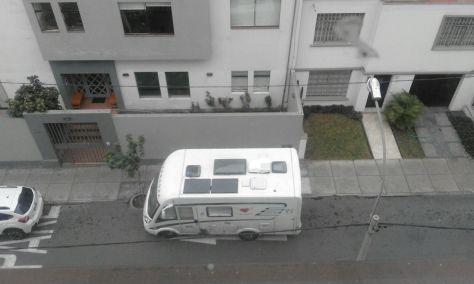
Am nächsten Morgen fahren wir nach Lima. Dort stehen wir mit Esperanza wieder in Miraflores, in einer Nebenstraße vor dem Haus, in dem unsere lieben Freunde Belita und Arturo (Link einbauen) wohnen, seitdem sie vor ein paar Monaten Los Angeles verlassen haben, wo sie viele Jahre gelebt haben.
Ein letztes Mittagessen bei Jorge und Iris, eine letzte – zufällige – und bewegende Begegnung mit Fernando, einem der Brüder von Clemencia:


Ein letzter Besuch und ein Mittagessen bei Pablo, dem ältesten Bruder von Clemencia und seiner lieben Frau Cecilia, die sich von einer schweren Erkrankung erholt. Paty, deren Tochter und Nichte von Clemencia, mit der sich Clemen eng verbunden fühlt, ist auch dabei. Clemen strahlt und ist glücklich bei ihrer Familie.


Und am Abend sind wir bei Eduardo eingeladen … einem „Beinahe-Bruder“ von Clemencia. Eduardo war einmal Freund und Ehemann von Clemen, das ist schon lange her, etwa vierzig Jahre. Es ist eine gefühlvolle Wiederbegegnung. Eduardo, der Chilene ist, und Elke, seine deutsche Frau, geben uns viele Ratschläge für unsere Reise in den Süden. Vor mittlerweile fast 20 Jahren war Elke auch einmal Teilnehmerin in einem meiner Seminare, die ich als Fachberater in Südamerika am Colegio Alemán Alexander von Humboldt in Lima veranstaltete. So ist das Leben!
Gut möglich, dass wir die beiden in ein paar Monaten dort unten wieder treffen, denn sie haben auch geplant, in diesem Sommer nach Tierra de Fuego zu fahren. Hoffen wir, dass es klappt.
Nach diesen letzten familiären Begegnungen müssen wir nur endlich los:
Am 20.10. geht es von Lima nach Puerto Inca (ca. 600 km), wo wir direkt am Meer vor einem Hotel einen schönen Standplatz finden; am 21.10. bis nach Manquague (ca 600 km); am 22.10. bis zur Grenze und anschließend nach Arica in Chile (ca. 300km):
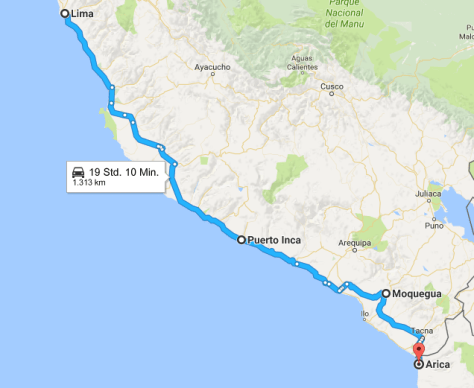
Die Fahrt durch den Süden von Peru ist ein besonderes Erlebnis. Hinter Puerto Inca führt die Panamericana fast nur noch am Meer entlang. Die Küste ist bergig und wild. Ähnlich wie im Norden des Landes gibt es kaum noch Vegetation. Nur in den Flusstälern, die sich von den Bergen zum Meer erstrecken, bilden sich grüne Oasen. Dort liegen auch die wenigen Orte, die wir unterwegs durchqueren.
Ansonsten nur trockene, schroffe Berge. Gegen Abend wirken sie besonders rot. Das sind Bilder und Perspektiven, wie wir sie von NASA-Fotos und Videos vom Mars kennen:
Schließlich erreichen wir die Grenze. Moderne Gebäude, eine sehr gründlich Abfertigung mit Drogenhund und Scanner für Teile unseres Gepäcks, aber freundliche Grenzer und insgesamt doch recht zügig. Als wir es geschafft haben, atmen wir auf. Es ist interessant zu beobachten, wie sich auf wenige Kilometer Entfernung die Tonlage im Spanischen ändert … auch zu meiner Verzweiflung, weil ich mich jetzt erst wieder an den neuen Tonfall gewöhnen muss.


Endlich in Chile. Nach den fast acht Wochen in San Pedro de Saño haben wir das Gefühl, einen ruhigen und sicheren Hafen erreicht zuhaben. In Chile haben wir ja schon einmal zwei Jahre gelebt und fühlen und Clemen hat hier auch Wurzeln aus ihrer Studentenzeit mit Eduardo. Deswegen fühlen wir uns hier auch irgendwie zu Hause, die ganzen Grenzen, die uns teilen, sind ohnehin nur Erfindungen der Politiker oder einflussreicher Leute, die ein persönliches oder ökonomisches Interesse daran haben Mauern hochzuziehen … Bis hinunter nach Antofagasta war die Gegend, die heute Teil von Chile ist, peruanisches und bolivianisches Staatsgebiet. Der Krieg, der Ende des 19. Jahrhunderts zu den heutigen Grenzen führte, trägt den Namen Salpeter-Krieg (link einfügen), – was natürlich deutlich macht, warum Chile diesen Krieg begann: angeblich um die Interessen der chilenischen Minenindustrie in den Nachbarländern schützen.
Die Fahrt durch den äußersten Norden von Chile bis nach Arica zieht sich hin. Bis auf eine längere Baustelle ist die Straße gut. Die Landschaft relativ eintönig, extrem trocken und lebensfeindlich. Wir sind froh, am späten Nachmittag endlich in Arica anzukommen.
Wir haben auf unserer raschen Fahrt in den Süden viele der wunderschönen Sehenswürdigkeiten, die Peru zu bieten hat, nicht besucht, weil unser Aufenthalt in der Albergue absolute Priorität hatte. Wir hoffen aber, dass wir im April des kommenden Jahres wieder nach Peru zurückkommen und dann mehr Zeit haben werden, all die wunderschönen und bedeutenden Ort zu besuchen, die wir diesmal verpasst haben.
JW/Clea
El tiempo se hace corto …
Tenemos que abandonar Perú a más tardar el 23 de octubre. Hasta ahí tiene Esperanza visa.Como queremos estar dos días en familia en Lima, dejamos el albergue el día 16 de Octubre.
Luego de pasar una última noche en Concepción con nuestros nuevos amigos Gladys e Isidoro partimos el 17 de octubre pasando Ticlio hasta Chaclacayo. Observo que apenas necesitamos combustible … claro, si vamos cuesta abajo desde las alturas de los Andes hacia el nivel del mar.
Al día siguiente estamos otra vez en Lima con Esperanza en pleno Miraflores al lado de la casa donde viven Belita y Arturo (link), amigos que dejaron Los Angeles hace unos meses, donde vivieron muchos años, para regresar al Perú.
Un último almuerzo con Jorge e Iris, luego un encuentro casual y muy emotivo con Fernando, otro de los hermanos de Clementina.
Una visita a Pablo, hermano mayor con su esposa y querida Cecilia, acompañados con Paty, sobrina entrañable de Clemen. Clemen feliz, cerca de su familia.
Y en la noche una visita donde Eduardo … otro casi hermano de Clemen. Eduardo fue compañero y esposo de Clemen en otras épocas. Fue un reencuentro cálido. Eduardo, quien es chileno de nacimiento y Elke nos dieron muchos impulsos para el viaje al sur. Curioso fue también que Elke recordaba haber sido ¨mi alumna¨ en uno de mis seminarios … Lo que es la vida … hace más de 40 años!
Es muy probable que los encontremos en unos meses abajo pues planean partir hacia Tierra del Fuego. Ojalá.
Después de todos estos encuentros familiares, partimos finalmente:
El 20.10 viajamos de Lima a Puerto Inca (aprox. 700 km) donde parqueamos directamente al lado del mar. El 21.10 llegamos hasta Moquegua (otros 400 km). El 22.10. cruzamos finalmente la frontera con Chile y llegamos a Arica (300 km).
El trayecto hacia el Sur en Peru es una experiencia especial. Después de Puerto Inca vamos siguiendo prácticamente el mar. La costa es salvaje y y al igual que en el Norte del país no hay casi vegetación. Solamente en los valles que van de las montañas hacia el mar vemos oasis de verdor, que resultan las únicas poblaciones que reconocemos en el camino.
Por lo demás cerros secos y rojos. Me recuerdan a fotos que he visto de la NASA de Marte.
Finalmente llegamos a la frontera. Edificios modernos, inspección exhaustiva con perro buscador de droga y escaneado de todo nuestro equipaje, gente muy cordial y muy eficientes. Respiramos cuando finalmente cruzamos la frontera. Es interesante escuchar cómo de unos kilómetros a otros … la melodía del español cambia … para mi desesperación, porque tengo que acostumbrarme a la nueva tonadita.


Finalmente en Chile. Después de las 8 semanas en San Pedro de Saño tenemos la sensación de haber llegado a un puerto tranquilo y seguro. En Chile vivimos ya dos años y Clemen tiene raíces aquí claro, de su época estudiantil con Eduardo. Por lo tanto nos sentimos un poquito como en casa, total las fronteras son inventos de los políticos o personas importantes que tienen especial interés en construir muros… Hasta parte de Antofagasta era esta parte de Chile territorio peruano. La guerra que tuvieron los países hacia fines del siglo 19 y que llevó a la creación de estas fronteras es la famosa guerra del salitre o Guerra del Pacífico. Lo que hace también claro porque Chile inició la guerra: al parecer por defender los intereses de la industria minera en los países vecinos
El viaje por el extremo norte de Chile parece largo. La carretera es buena, menos en un sitio de obra muy largo. El paisaje es monótono, extremamente seco y sin vida ninguna. Nos alegra llegar en Arica en la tarde.
Muchas cosas hermosas que tiene el sur de Perú esperándonos, pero nuestra prioridad fue el albergue y esperamos que en Abril 2017 lo haremos con más tiempo para ver y visitar todos los hermosos e importantes sitios del Perú, que nos perdimos esta vez.
JW/Clea
We are running out of time.
We have to leave Peru on October 23 at the latest; on this day our permit for the temporary importation of Esperanza will expire. Since we also want to spend at least two more days in Lima, before taking off to the border with Chile, we have to leave the albergue on October 16.
After al last night with our new friends Gladys and her husband Isidoro in their house in Concepción, not far from the albergue, we finally leave the area on October 17 and drive back to Chaclacayo (link einbauen) across the Ticlio-Pass (Link einbauen). While driving I recognize that we do not need much diesel on the way back. No surprise, because we drive down from the extreme heights oft he Andes to almost sea-level.
On the next morning we drive from Chaclacayo back to Lima. There we park our motorhome in Miraflores again, in a side street in front oft he house, where our dear friends Belita and Arturo (link) live, since they left Los Angeles, a couple of months ago.
A last lunch at Jorge’s and Iris’s, a last, accidental, and moving encounter with Fernando, one Clemencia’s brothers in the street.


A visit to Pablo, Clea’s oldest brother and his dear wife Cecilia. Paty, their daughter and Clemencia’s nice, who is emotionally very closely related with Clemen, accompanies us. Clemen is beaming with happiness being with her family.
In the evening we have dinner at Eduardo’s home. Clemen calls him another „almost“ brother. He was her husband about forty years ago. Ever since that time they have been very good friends.
It is a very emotional re-encounter. Eduardo, who is Chilean, and his German wife Elke, give us a lot of useful pieces of advice for our trip to Chile. We also find out that Elke once took part in one oft he workshops, which I presented during my times as a consultant for German in South America at the Colegio Alemán Alexander von Humboldt in Lima about twenty years ago. Such is life.
It is possible, that we will meet Eduardo and Elke again in a couple of months, because they have also planned to travel to Tierra de Fuego this summer. Let’s hope, it will work out that way.
After these last family encounters finally we have to leave Lima.
On October 20 we leave Lima and head for Puerto Inca (about 370 miles), where we find a good hotel with camping facilities on he beach; on 10/21 we drive to Manquague (another 370 miles); on 10/22 we cross the border to Chile and drive to Arica. (about 180 miles)
Driving through the south of Peru is an extraordinary experience. Beyond Puerto Inca the Panamericana follows almost exclusively the coastline. The coast is wild and mountainous like in the north of Peru. There is almost no vegetation. Only in the river valleys, which come down from the Andes, you can find some oasis-like areas and some very small towns:
Otherwise there are only very dry and cliffy mountains. Towards evening their color turns into a real red. It is pictures and perspectives, which we only know from NASA-photos of Mars.
Finally we reach the border to Chile. Modern buildings, a very thorough search with a drug dogs and scanner of parts of our baggage, but friendly customs officers and a rather fast kind of procedure.
After we have passed through, we take a deep breath. It is interesting to observe how the tone of Spanish changes within a couple of miles only — a little bit to my personal despair, because I have to accustom again to the new kind of Chilean pronunciation.
At last we are in Chile. After almost eight weeks in San Pedro de Saño we are happy that we have reached a really safe and quiet haven. We know Chile a little bit, because we lived here for two years at the turn of the century and Clemen has roots in Chile since she studied here and met Eduardo. Therefore we almost feel like at home, the borders that divide the world are mainly inventions of politicians or people who have a personal or economic interest in building walls … Down to Antofagasta the area, which is now part of Chile, used to be Peruvian and Bolivian. The war at the end of he 19th century, which led to today’s borders, was called the War of the Pacific or the Sulphur War, – which shows, why Chile started it, pretending to protect the interest of their investments in the miner industry in the neighboring countries.
The drive through theextreme north of Chile is boring. The road is good with the exception of a long construction site. The landscape is monotonous, extremly dry and hostile to life. We feel happy when we finally arrive in Arica in the late afternoon.
On our speedy trip through the south of Peru we did not visit any of the famous sights, which Peru has to offer there, because our time in the albergue had had absolute priority for us and because we are planning to return to Peru anyway in April next year. We hope we will have more time then to see and visit all the beauties and sights of Peru, which we missed this time.
JW/Clea
Nach zwei Monaten in San Pedro de Saño werden wir von den Mädchen der Albergue, vom Personal und von der Junta der ONG Apoyame Perú sehr herzlich und mit viel Kreaitivität verabschiedet. Mit uns verlassen Cindy und Roy die Albergue, die uns in der letzten Woche mit ganzer Kraft unterstützt haben:
Wir selbst müssen Peru sobald wie möglich verlassen, weil unsere Visa und vor allem die vorübergehende Einfuhrgenehmigung für die Esperanza auslaufen.
Nach diesen beiden anstrengenden Monaten sind wir einerseits froh, ab morgen endlich wieder einmal frei durchatmen zu können, andererseits sind wir traurig, weil wir die Mädchen zurücklassen müssen. Es war ein sehr intensives gemeinsames Erlebnis.
Wir haben versprochen, in ein paar Monaten wiederzukommen. Etwa Ende März, Anfang April 2017. Mal sehen, ob das klappt.
JW/Clea
Despedida
Después de dos meses en San Pedro de Saño nos hacen una despedida muy afectuosa y creativa tanto por parte de las niñas como del personal y la Junta de la ONG Apóyame Perú
Tenemos que dejar Perú rápidamente porque la visa se vence, sobre todo el permiso de importación de Esperanza.
Después de este tiempo intenso estamos felices de partir y respirar más libremente sin tantas obligaciones pero también muy tristes porque tenemos que despedirnos de las niñas. Es siempre una experiencia muy intensa con ellas.
Hemos prometido volver en unos pocos meses aproximadamente a comienzos de Marzo o Abril 2017 más o menos. A ver si eso se puede realizar.
JW/Clea
Farewell
After two months in San Pedro de Saño the girls of the albergue, the personnel and the Junta of the NGO Apóyame Perú bid us farewell in a very loving and creative form.
We have to leave Perú as soon as possible, because our visas and the temporary permit of importation for Esperanza is going to expire very soon.
After these two stressful months we are happy on the one hand to be able to breathe freely again, but on the other hand we are sad, that we have to leave the girls behind. It has been a very intense common experience.
We have promised to be back in a couple of months. Let us see, whether this will be possible.
JW/Clea

 Unterwegs in Europa, Amerika und Asien